
Panelling Board 2026: Complete Buying Guide, Types & Design Ideas
Home » Panelling Board 2026: Complete Buying Guide, Types & Design Ideas
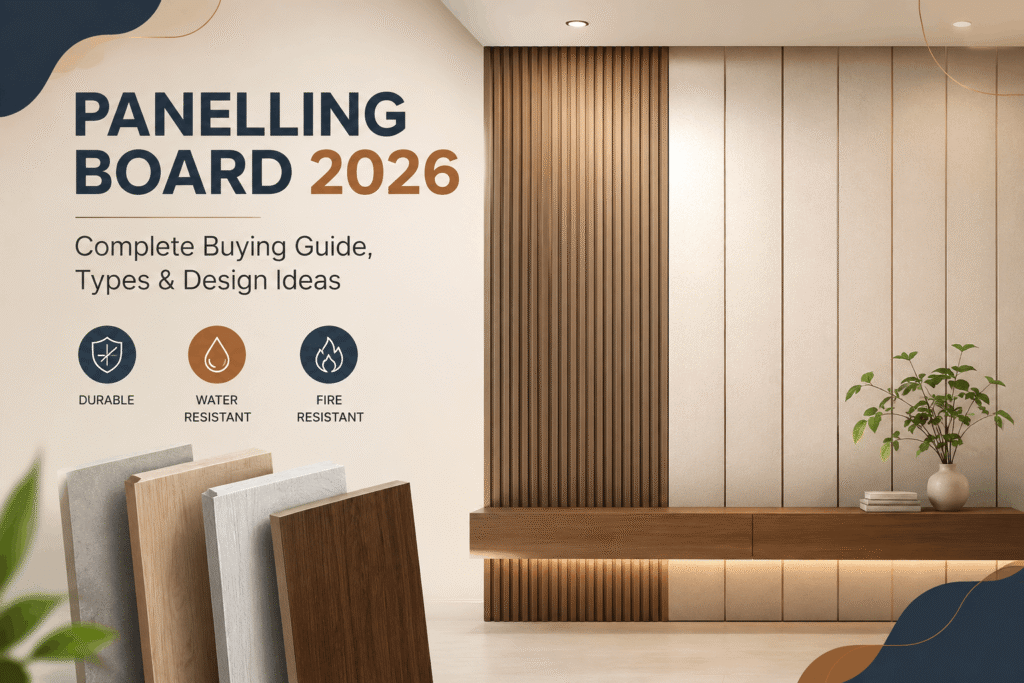
Most People Choose the Wrong Board First… Then Learn the Hard Way!
If you walk into any hardware store today and ask for a panelling board, you’ll get options instantly. Plywood. MDF. Something “premium”. Something “budget”.
It feels simple. But here’s what usually happens after a year or two. Edges start swelling, the finish doesn’t look the same, doors stop closing properly, and kitchen cabinets feel weak.
And suddenly, that “good deal” doesn’t feel so good.
This is why panelling is changing in 2026. People are no longer choosing just for looks. They are choosing how the material behaves after daily use.
Let’s proceed gradually. No confusion. No technical overload.
First, What Exactly Is a Panelling Board?
A panelling board is not just something you stick on a wall.
It becomes part of your space.
It can be:
- A wall surface
- A cabinet body
- A partition
- Even part of your door
So, when you pick one, you are not choosing decoration. You are choosing something that will handle pressure, moisture, and time.
That’s why calling it only a Designer board is a bit misleading. Design is just one part of the story.
The Reality of Materials (What People Don’t Tell You)
Let’s talk honestly about the options you’ll see in the market.
Plywood: Still very common. Looks reliable.
But in real homes:
- It slowly absorbs moisture
- Needs chemical protection
- Termites are always a risk
It works, but it needs maintenance.
MDF and Particle Boards: These are everywhere because they are affordable. They feel smooth. Easy to shape.
But:
- Water is their biggest enemy
- They lose strength faster than expected
- Once damaged, you usually replace them
They are fine for light use. Not for heavy use.
Gypsum Boards: Mostly used for ceilings. They give a clean finish. But they are not strong. You cannot depend on them for structural use.
Cement Panel Board: This scenario is where things get interesting. A cement panel board like Bison Panel is built differently from the start. It mixes cement with treated wood particles. That combination changes how the board behaves.
Instead of choosing between strength and flexibility, you get both.
Which means:
- It doesn’t swell like wood-based boards
- It doesn’t crack easily
- It handles moisture better
- It stays stable over time
That’s why many professionals now treat it as a reliable designer board, not just an alternative.
How do people actually choose?
Most buying decisions are not logical. They are quick.
Let’s slow that down. Before choosing a panelling board, ask yourself these simple questions.
Where will you use it?
Sounds obvious, but many people ignore these factors.
For example:
- Panels for the kitchen face steam, heat, and oil
- Partition boards handle movement and impact
- Doors face daily stress
If the board does not suit that environment, problems show up slowly.
How long do you want it to last?
Be practical. If you are renovating for the next 2–3 years, you can compromise.
But if this is your long-term setup, then durability matters more than price.
What kind of weather does your home face?
In India, humidity is a big factor. Even if your room feels dry, the material still reacts to air moisture over time.
This area is where many boards fail quietly.
Will it handle daily usage?
A decorative wall is one thing. A panel door design is different. It is used every single day.
A kitchen cabinet is opened and closed multiple times. Weak boards don’t fail instantly. They lose strength slowly. That’s worse.
Are you okay with future repairs?
This is the most important question.
Because cheaper boards often mean the following:
Repairs
Replacements
Extra labour
And that adds up.
Design Ideas That Work in Real Homes
Let’s move to design. But practical design.
Living Room Walls That Stay Sharp: Textured walls look stunning at first. But if the base is weak, the edges chip and joints become visible. A strong panelling board keeps the finish intact for longer.
Panels for Kitchens That Don’t Give Up: Kitchens test materials every day.
Heat. Steam. Cleaning.
Using proper panels for the kitchen avoids the following:
- Swelling corners
- Loose laminates
- Weak cabinet bases
This is one area where material choice really shows.
Partition Boards That Feel Solid: Open layouts are common now. Instead of building walls, people use partition boards.
But if the board is not strong, the structure feels shaky. A good board makes partitions feel permanent rather than temporary.
Panel Door Design That Doesn’t Warp: Doors are often overlooked. A stylish panel door design is excellent. But it must stay straight.
Warping, bending, or termite damage ruins both function and look.
Exterior Use: Many people don’t think about exterior panels until damage appears. Rain, sunlight, and dust slowly affect materials.
A cement panel board performs better here because it is built to handle exposure.
Where does Bison Panel fit into all these scenarios?
Now, if you connect all these points, one thing becomes clear.
Most materials force you to choose:
- Strength or flexibility
- Design or durability
- Interior or exterior use
Bison Panel reduces that confusion.
It works across multiple use cases:
- Kitchen
- Partitions
- Doors
- Exterior surfaces
That makes it a dependable panelling board, not a limited-use material.
And since it comes from NCL Industries, it carries a level of manufacturing reliability that smaller brands often cannot match.
This matters more than people think because consistency in material quality is what prevents long-term issues.
Mistakes People Realise Only After Installation
You’ll hear these often. “I wish we had chosen better material.” Here’s what usually leads to that.
Fact: Choosing based on price alone.
Reality: Cheap materials seem attractive, but problems come later.
Fact: Trusting suggestions without understanding.
Reality: Even experienced workers may prefer what is simple to install rather than what lasts longer.
Fact: Ignoring the environment.
Reality: Moisture, heat, and usage conditions matter more than design.
Fact: Assuming all boards are similar
Reality: This assumption is probably the biggest mistake. They may look similar on the outside. They behave very differently over time.
Conclusion
If you think about it, a panelling board is something you live with every day. It’s not like paint that you can recreate effortlessly. Once it’s installed, it stays there, handling everything quietly. That’s why rushing this decision doesn’t make sense.
A slightly better choice today can save you from several small frustrations later. In the end, the right board is the one you don’t have to think about again.
FAQs
1. Which panelling board actually lasts longer?
Usually, these are the ones that don’t react much to water or termites. That’s why people lean towards stronger, cement-based options for longer use.
2. Are panels for the kitchen really different from normal ones?
Yes, they go through more stress, heat, steam, and cleaning, so regular boards don’t always hold up well there.
3. Do partition boards feel strong enough in daily use?
Depends on the material. Some feel solid; some feel a bit hollow after a while.
4. What should I check in the materials for panel door design?
Just check if it stays straight. If it bends later, it becomes irritating.
5. Is a cement panel board okay for outside use?
Yes, it’s actually one of the safer choices for outdoor areas because it handles weather better than most wood-based boards.