Fire-Resistant Panels for Modern Construction
Home » Fire-Resistant Panels for Modern Construction
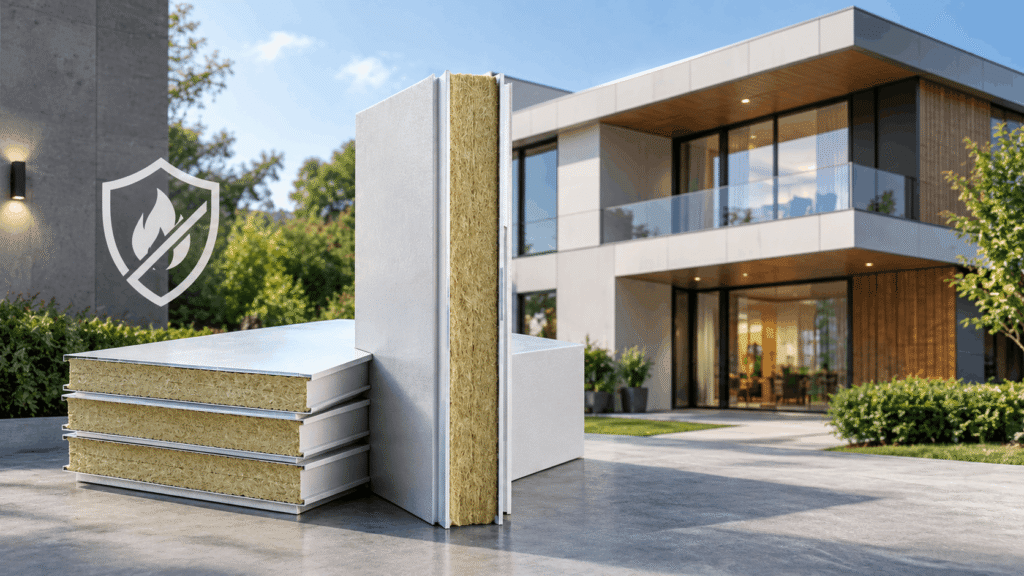
Let’s be clear for a moment. When you’re picking materials for a new office or renovating your home, your brain usually goes straight to the pretty stuff. Paint shades. Tile patterns. The shine on the hardware. But here’s the ugly truth nobody likes to talk about over coffee with their architect: what happens if a fire breaks out?
That sleek plywood cabinet you love? It can become kindling in under a minute.
That’s where fire-resistant panels enter the chat, not as a boring technicality buried in the fine print, but as a genuine, non-negotiable lifesaver. And if you’ve spent any time in the Indian construction scene over the last thirty years, you already know the heavyweight champion in this category. It’s Bison Panel. No contest.
Bison Panel is a cement-bonded particle board, but calling it just a “board” feels like underselling it. It’s a hybrid monster. NCL Industries brought this tech to India way back in ’92, collaborating with the German giants at Bison Werke. The idea was brutally simple: take the rugged, unshakeable strength of cement, marry it to the workability of wood, and create something that actually fights fire, moisture, and pests.
Let’s dig into why this stuff matters more than your average drywall.
Why Fire-Resistant Panels Are the Smart Choice
Here’s a hard pill to swallow. Most builders still compromise on safety to save a few hundred rupees per square foot. They’ll use commercial plywood, add some cheap MDF, and be done with it. But that math doesn’t pan out. Not when you factor in insurance, longevity, and the sheer terror of a spark turning into a roaring blaze.
Fire-resistant panels like Bison change that picture. They aren’t just “less flammable.” They actively stop the spread.
Built for Safety, Strength, and Long-Term Performance
Let’s get nerdy with the numbers for a minute because the data here is genuinely impressive. Bison is made of 62% Portland cement, 28% wood particles, and 10% water and chemicals. Those wood chips are mineralised during production, which means termites literally cannot digest them. Gross, but effective.
Now, the fire bit. Bison has been tested against the British standard BS 476. It walked away with a Class ‘O’ rating and a Class 1 surface spread of flame. Translated to plain English? It doesn’t catch fire easily, and if it does, the flames spread across it very slowly.
But this is the part that really excites me. You can use this stuff to build structural elements that hold back a blaze between 30 minutes and 4 hours. Four hours! That’s the difference between a building standing tall and a building reduced to ash. That’s time for firefighters to arrive, time for families to evacuate, and time to save what matters.
And because it’s a non-combustible building material that also laughs at moisture, you aren’t sacrificing durability for safety. It’s BIS certified (IS 14276-1995) and meets GRIHA standards for green buildings. Zero asbestos. Zero formaldehyde. Just solid, heavy-duty protection.
Fireproof Panels That Protect Every Space
You might think these heavy-duty boards are only for industrial factories or high-rise commercial blocks. You’d be wrong.
The beauty of fireproof panels is their chameleon-like ability to fit into literally any space. Whether you’re dealing with a bustling corporate office that needs to pass strict safety audits or a cosy residential kitchen where you fry fish every other night, Bison integrates seamlessly.
Reliable Solutions for Homes, Offices, and Commercial Buildings
Stop thinking of these as just “wall things.” Look around your space right now.
- Ceiling boards: Put them up in your false ceiling. They stop a fire from racing into the roof cavity.
- Partition wall panels: Whether they’re single-skin dividers or double-skin drywall with steel studs, they create robust, safe zones.
- Interior wall panels: Clad your living room or hallway in them, and you’ve got an aesthetic that also doubles as a shield.
- Furniture: Modular kitchens, wardrobes, heavy storage racks Bison takes the load without buckling.
What I love about these fireproof panels is the unexpected bonus: silence. They are dense (1250 kg/m³), so they kill sound dead. In an office, that means fewer distractions. In a hospital, quieter recovery rooms. In a hotel, guests actually sleep through the night.
Plus, they insulate against heat. With a thermal conductivity of just 0.192 W/mK, these fire-rated building panels keep summer heat outside and winter chill inside. That means your AC works less, your heater works less, and your electricity bill drops. Safety that saves you money? That’s a win-win.
Fireproof Wallboard for Stronger Interiors
I’ll be brutally honest here: the interior walls in most Indian homes are a ticking time bomb. We use cheap ply, and the moment the monsoon hits, they swell up like a sponge. Then the termites show up, and you’re shelling out thousands on pest control.
Cut that nonsense out.
Resistant to Fire, Moisture, and Termites
Bison is the fireproof wallboard you actually want holding your house together. It doesn’t warp when it gets humid. It doesn’t rot when it rains for a week straight. And the termites? They take one bite and promptly starve because the wood particles are mineralised cement. Seriously.
But let’s focus again on the fire aspect, because that’s the main point. These fire-resistant wallboards don’t give off toxic fumes when heated – a huge problem with synthetic boards. They maintain their structural integrity even under extreme heat.
If you’re building a kitchen, you know the heat from your stove and oven can slowly degrade cheap materials. Not here. Bison handles temperatures from -40°C to +90°C without cracking a sweat. That’s why it’s also a stellar heat-resistant panel for industrial settings.
Oh, and did I mention it doesn’t support fungal growth? In coastal cities like Mumbai or Chennai, this material is a godsend. It’s also a brilliant moisture-resistant board for basements and bathrooms. The board basically says “no” to everything that destroys normal interiors—fire, water, bugs, and mould.
Why Choose Bison Fire-Resistant Panels?
By now, you might be thinking, “Okay, this stuff sounds pretty impressive, but why Bison specifically? There are other players in the market.”
Fair question. Let’s break down the “why.”
Sustainable, Durable, and Designed for Modern Construction
First, the pedigree. This is a product you can trust. NCL Industries brought in technology from Bison Werke of Germany, the global OG in particle board engineering. That German precision isn’t just a sticker on a box; it dictates manufacturing standards, density control, and quality checks.
Second, the scale. NCL runs two top-tier plants in Mattapalli (Telangana) and one massive facility in Paonta Sahib (Himachal Pradesh). Combined, they churn out 90,000 metric tonnes annually. That supply chain muscle means you’re never waiting months for your order. You get consistency, batch after batch.
Third, sustainability. Bison use wood from fast-growing plantations like eucalyptus and poplar, so they’re not chopping down ancient forests. They use fly ash (a byproduct of thermal plants) in the cement mix, reducing industrial waste. It’s IGBC-certified and meets green building standards.
Fourth, the cost breakdown. Yes, the upfront price is slightly higher than basic commercial ply. But let’s do the long-game math. You won’t spend a rupee on termite sprays. You won’t spend on replacing swollen panels after the rains. You won’t spend on painting over fire damage. Spread that extra cost over 25+ years (its actual lifespan), and Bison is ridiculously cheaper.
If you’re an architect, a builder, or just a stressed-out homeowner, Bison fire-resistant panels help you feel more secure. And honestly? You can’t put a price on that.
Conclusion
Look, construction is moving fast. The old guard of buying the cheapest plywood and praying for the best is over. We are building smarter, taller, and denser. That demands materials that perform well.
Fire safety isn’t a checkbox. It’s a responsibility. When you choose Bison, you’re choosing a board that has been battle-tested in Indian conditions for over three decades. You’re choosing strength, sustainability, and the assurance that if the worst happens, you’ve bought yourself precious time.
Don’t gamble with your interiors. Stick with the original. Stick with Bison.
FAQs
Q1: How do Bison panels react when exposed to direct flames?
They char on the outside and then stop burning. The core stays rock-solid, holding the flames back for up to four hours. It essentially gives you that critical window to get out.
Q2. Can I cut and machine Bison panels like regular wood?
Absolutely. You can nail, drill, cut, and screw them using standard carpentry tools. That’s the whole point. They give you the workability of wood with the strength of concrete.
Q3: Are these panels suitable for high-humidity regions like Goa or Kerala?
Absolutely. Unlike plywood, which swells into a warped mess, Bison stays put in coastal humidity. No mould, no rot. It actually thrives where other materials fail.
Q4: Is Bison Panel environmentally sustainable?
Pretty impressively so. It’s plantation wood, recycled fly ash, and zero nasty formaldehyde, plus it holds GRIHA and IGBC certifications. It’s green building done right.
Q5: What standard sizes do Bison panels come in?
You can grab them from 6mm up to 40mm thick. Standard sheets come in 8×4 feet or 10×4 feet, which is enough for most wall and ceiling jobs.
Q6: How does the cost of Bison compare to regular plywood over time?
Sure, the sticker price stings a bit more upfront. But skip the pest sprays and dodge the monsoon replacements for 25+ years? Honestly, it works out cheaper than cheap ply.