
Kitchen Panels for Durable Interiors
Home » Kitchen Panels for Durable Interiors
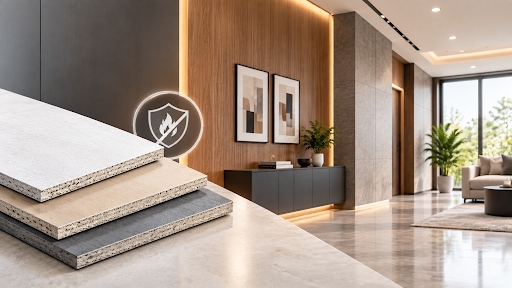
Picture this. You’ve just sunk ₹2.5 lakh into that sleek modular kitchen in your new Kokapet apartment. The acrylic shutters are glossy. The quartz countertop gleams. Six months later, the Hyderabad monsoon hits. You open the bottom cabinet to grab some turmeric, and boom, the plywood base has swollen up like a spoilt sponge. The hinges have popped out. The carpenter gives you that look and says, “Saar, moisture damage. Full replacement.”
We’ve seen this scene play out a hundred times. In Kukatpally. In Miyapur. Even in those fancy high-rises near the Outer Ring Road. That’s exactly why we started manufacturing Bison Panel, a cement-bonded particleboard that won’t betray you when humidity spikes.
For over 30 years, we’ve been making these kitchen panels right here in Telangana. Our Mattapalli factory is just a few hours from Hyderabad. And honestly? We built this product because we were tired of seeing hard-earned money go down the drain on materials that couldn’t handle Indian cooking.
Kitchen Panels for Functional and Stylish Spaces
Walk into any interior design studio in Banjara Hills today. The mood boards are stunning Italian marble, matte-finish laminates, and handleless cabinets. But here’s the uncomfortable question nobody asks: “What’s that cabinet made of?”
Most will mumble “boiling water-resistant ply” or “marine grade.” But we know the truth. Even the best plywood has a glue line. And that glue? It degrades when your pressure cooker releases steam at 100°C day after day.
Our kitchen panels are a different beast entirely. We mix 62% ordinary Portland cement with 28% wood particles (sourced from fast-growing Eucalyptus and Poplar plantations), and the rest is water and a bit of non-hazardous chemistry. The technical collaboration with Bison Werke of Germany, the global pioneers in this space, ensures that every board that rolls out of our factory meets international benchmarks.
Here’s what that chemistry delivers for your Hyderabad kitchen:
- It won’t swell. Water spills? Steamy idli stand? The cement matrix locks everything in place. Dimensional stability is through the roof.
- It won’t burn. Tested to Class ‘O’ building standards. We’re talking 30 minutes to 4 hours of fire resistance while your gas stove is running non-stop during Sankranti feasts.
- Termites hate it. Because the wood particles are fully mineralised in the cement mix, pests can’t digest them. No termite treatment, no chemical sprays.
- Zero asbestos, zero formaldehyde. Safe enough to use in your toddler’s room, let alone your kitchen.
Available from 6mm up to a chunky 40mm thickness and in 8×4-foot sheets, these kitchen panels give you the raw strength of concrete and the workability of pinewood. Your carpenter can cut, drill, and router them without needing diamond-tipped tools.
Why Kitchen Panels Are Ideal for Modern Kitchens
Let’s be blunt. Modern kitchens aren’t just about aesthetics anymore. They’re about performance under stress.
Think about your average weekday evening in a Hyderabad household. You’re making khatti dal on one burner and bagara baingan on the other. The exhaust fan is running, but the cabinets above the stove are still taking a heat bath.
With plywood, that heat accelerates the breakdown of phenolic resins. The result? Warped doors that won’t close properly. Shelves that sag under the weight of your stone grinders.
Our kitchen panels shrug off that heat. The cement in our boards acts as a natural thermal insulator. We’ve got architects in Gachibowli specifying our 16mm and 18mm variants specifically for cabinet boxes because they know the hinges won’t pull out after two years.
And here’s a small secret we tell our dealers in Secunderabad: because the board is so dense (1250 kg per cubic metre), it also deadens sound. Is your dishwasher running at 10 PM? The neighbour in the next flat won’t hear a thing. That’s the kind of functional upgrade that makes modern Hyderabad apartments feel truly premium.
Panels for Kitchen Applications and Designs
When we say panels for the kitchen, we aren’t just talking about cabinet boxes. Honestly, that’s the boring part. Over the years, we’ve watched Hyderabad’s interior designers get wildly creative with our material, and it still surprises us.
Cabinetry & Shutter Cores: This is the bread and butter. Build the entire carcass using our boards. Since it doesn’t absorb moisture, your soft-close hinges stay perfectly aligned for decades. No sagging, no settling.
Open Shelving: Those Instagram-worthy open shelves with the copper pots? Use our 12mm panels. They have the flexural strength to hold heavy cookware without bowing, and because they’re termite-proof, you don’t have to panic about tiny bugs getting into your dal containers.
Backsplash Panels: Instead of ceramic tiles with grout lines that turn black with grease, we’ve seen designers use a single 8mm Bison sheet as a full backsplash. Just seal the edges properly, and you have a seamless, industrial-chic surface that wipes clean with a wet cloth.
Kitchen Platforms: The 20mm and 25mm variants are absolute beasts. We recently supplied sheets for a home in Nallagandla where the homeowner wanted a heavy-duty platform for kneading atta daily. The platform is solid as a rock, with zero flex.
And here’s the kicker: because our boards are eco-friendly and IGBC-certified, we’re seeing a surge in demand from green building projects near the Financial District. Builders are realising that using panels for kitchens made from recycled wood waste and cement actually improves their projects.
Kitchen Floor Design Ideas for Modern Homes
Alright, let’s address this head-on. You might be wondering why a cement-board manufacturer is talking about kitchen floor design ideas. We get it. We’re not a tile company.
But here’s the insight we’ve gained from working with thousands of Hyderabad homeowners. The floor and the cabinetry are locked in a constant battle with moisture. You mop the floor. That water seeps into the joint where the cabinet meets the ground. If your cabinet base is plywood, it wicks that water up like a straw.
So, when we talk about kitchen floor design ideas, we’re speaking from a structural perspective.
Idea 1: The Full Matte Micro-Topping: We’re seeing a huge trend in Jubilee Hills and Banjara Hills for polished cement or micro-topping floors. They’re seamless, cool underfoot during Hyderabad’s scorching summers, and they pair beautifully with the raw texture of our cement panels. No grout lines mean no water seepage into the subfloor.
Idea 2: Large-Format Porcelain with a Wood-Grain Finish: If you want the warmth of wood without the warping, go for a 60×120 cm porcelain tile that mimics timber. Lay it on a perfectly level subfloor (ideally using our panels as an underlay for stability). The minimal grout lines make cleaning a breeze.
Idea 3: Terrazzo or Chips-Finished Cement: This is making a massive comeback in Hyderabad’s new boutique apartment complexes. It hides dust, handles dropped utensils without chipping, and gives a nostalgic nod to old city homes.
Regardless of which kitchen floor design ideas you choose, our advice remains: ensure your base cabinets have a moisture-proof kickboard. We often recommend fabricating that kickboard from our 16 mm Bison Panel. It keeps the rising damp away from your cabinets and ties the whole flooring ecosystem together.
The Hyderabad Factor: Why Local Weather Demands Better Panels
We’re headquartered right here at NCL Pearl on S.D. Road, Secunderabad. We’ve been part of this city’s skyline for decades. And we know our climate better than any imported material supplier ever could.
Hyderabad has this unique double whammy. The summer is dry, and blazing temperatures reach 45°C, drying out timber and causing deep cracks. Then suddenly, the monsoon arrives with that heavy, oppressive humidity that makes every wooden joint expand violently.
This constant expand-and-contract cycle is murder on standard particleboard and medium-density fibreboard. It’s exactly why our kitchen panels are engineered with such a high cement ratio. Cement doesn’t expand with humidity. It doesn’t contract with heat. It stays stable, neutral, and boringly reliable, which is exactly what you want in a material that costs you a fortune to install.
We’ve supplied panels for projects in Langar Houz, Mehdipatnam, and even the newly developing suburbs near Shadnagar. The feedback is always the same: “We should have used this earlier.”
Common Installation Mistakes (And How We Help You Avoid Them)
We don’t just sell boards and disappear. We’ve seen Hyderabadi carpenters and contractors make a few recurring errors with our material, and we want to share these so your kitchen doesn’t become a cautionary tale.
Mistake 1: Skipping the Edge Sealing: Yes, our board is water-resistant. But that doesn’t mean you should leave the cut edges raw near the sink. Use a high-quality PU sealant or edge-band the cuts. It takes five extra minutes and adds years to your cabinets.
Mistake 2: Using the Wrong Screws: Local carpenters often use standard wood screws that are too sharp. Our material needs self-tapping screws, preferably with a countersunk head. Pilot holes are your friend. Drill them, or you’ll split the surface.
Mistake 3: Ignoring the Expansion Gap: While our panels have minimal expansion compared to wood, we still recommend leaving a 2 to 3 mm gap between large sheets, especially near windows where direct sunlight hits. It’s a simple precaution that prevents any theoretical buckling.
We’ve trained our dealer network in Hyderabad to educate contractors on these nuances. If you’re buying from a verified distributor, ask them for the installation guide or call our Secunderabad office. We’re happy to walk you through it.
Conclusion
Look, we could throw more technical jargon at you: thermal conductivity coefficients, modulus of rupture, and all that. But here’s the bottom line. A Hyderabad kitchen is a war zone. It is heat, moisture, and heavy daily abuse. Your materials need to be chosen with the same care you’d pick a home.
Kitchen panels made from cement-bonded particle board aren’t a luxury. They’re an insurance policy against the heartache of rotten cabinets and inflated repair bills. We know because we’ve been making them for over three decades, right from our backyard in Telangana.
The next time an interior designer in Banjara Hills hands you a quote for a modular kitchen, ask them one question: “Are the base boxes Bison?” If they say no, ask them, “Why not?” Because once you use our panels for the kitchen, you experience the stability, durability, and sheer peace of mind; you’ll never go back to sucking up the cost of replacing plywood every few years.
Choose wisely. Choose materials that respect the heat of your stovetop and the humidity of our monsoon. Choose Bison Panel. We’ve got your back and your kitchen cabinets.
FAQs
1. Are Bison panels heavy to install in high-rise apartments like those in Kondapur?
It’s not light. It’s around 1250 kilos per cubic metre. But that weight is exactly what gives it that rock-solid feel. For high-rise apartments in Kondapur or Gachibowli, we usually tell contractors to stick to 12mm or 16mm for the cabinet bodies. That’s manageable for any decent labourer. Anything thicker? Cut it to size on the ground floor itself. Saves your workers a massive headache hauling it up 15 floors.
2. Can we use these kitchen panels near our sink without swelling?
Yes, but here’s the catch. You absolutely have to seal the cut edges. The board itself won’t swell because of the cement. But if water sits on an unsealed edge for days, you might see a dark patch over time. Just slap some PU sealant on the edges near the sink, and you’re sorted for life. We tell every customer in Hyderabad that our humidity is no joke.
3. Where can I physically see Bison Panel samples in Hyderabad?
Come over to our headquarters, NCL Pearl on S.D. Road in Secunderabad. We keep all the thickness variants and finishes there for you to see and touch. Or if you’re closer to Ameerpet or Kukatpally, we’ve got dealers there too. Just call ahead so someone’s free to walk you through the options properly.
4. Do you offer fire-rated kitchen panels for commercial projects near HITEC City?
We’ve done quite a few of those near HITEC City and the Financial District. Co-working spaces, office cafeterias, even that new food court near Cyber Towers. They all needed that 4-hour fire rating. Our panels meet Class ‘O’ standards per BS 476, so you’re fully compliant. Just tell your architect to specify Bison Panel in the BOQ, and we’ll handle the rest.
5. I’m renovating an old house in Musheerabad. Can I overlay these panels on existing tiles?
For wall cladding and backsplashes, yes, go ahead. Our 6mm or 8mm variants can go right over the old tiles with the right adhesive. But for cabinets? Don’t overlay. It’s asking for trouble. We always recommend ripping out the old plywood boxes and building fresh ones with our panels. For a false ceiling, though, you can definitely lay it right over the existing surface.
6. How do I clean grease off the kitchen panels?
A wet cloth and a drop of regular dishwashing liquid are all you need. That’s it. No fancy cleaners. But stay away from steel wool or acid-based bathroom cleaners. They’ll scratch the surface and ruin the finish. The beauty of our board is that grease doesn’t soak in because it’s non-porous. Just wipe and move on with your day.
7. Is there any formaldehyde smell after installation?
Not a whiff. Zero. We don’t use those formaldehyde resins that give cheap plywood that sharp, headache-inducing chemical smell. Our process uses cement, wood dust, and water. That’s literally it. Your kitchen will smell like fresh construction, not like a chemical factory. Even your cook won’t complain.
8. Can we use these panels for heavy-duty platform bases for tandoor or heavy cooking?
We actually went to a tandoor restaurant in Tolichowki last year. We insisted on the 25mm variant there. It withstands intense heat without cracking and doesn’t transfer to the platform base underneath. For home use, 20mm might suffice, but if you’re running a commercial setup, go with 25mm. That extra thickness is cheap insurance against heat damage.