
Ceiling Boards: Durable & Decorative Panels | Bison Panel
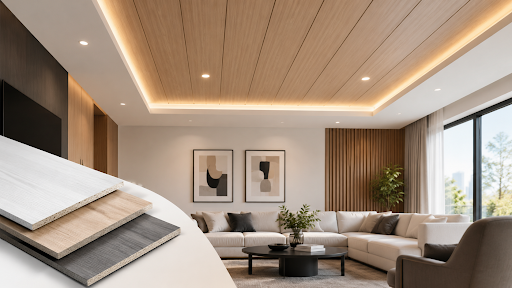
Ever walked into a room and felt the ceiling was just… wrong? Too low, too echoey, or worse, already showing those ugly water stains from last year’s monsoon?
Standard POP or gypsum just doesn’t cut it in Indian conditions unless you enjoy repairing cracks every two years. That’s where we come in. We’re NCL Industries, headquartered right here in Secunderabad, Hyderabad, and we’ve been manufacturing Bison Panel for over three decades. It isn’t plywood. It isn’t drywall. It’s a cement-bonded particle board, roughly 62% actual cement, mixed with wood fibre. Pick up a sheet, and you’ll feel the density immediately. No hollow thud. Just solid, heavy, reliable mass.
This isn’t a fancy new trend. Contractors across India have been swearing by our ceiling boards for over 30 years because they actually survive our climate.
Durable Ceiling Boards for Modern Interiors
Let’s talk about what “durable” actually means on a humid Tuesday in Mumbai or a scorching afternoon in Delhi. Most false ceiling boards swell, sag, or attract termites when humidity crosses 70%. Ours don’t. The wood particles inside are completely mineralised during manufacturing. Basically, the termites take one bite and move on. There’s nothing organic left for them to eat.
For modern interiors, our ceiling boards handle the heavy lifting. The standard 8mm thickness is stiff enough to span a 600 × 600 mm grid without bowing under its own weight. And here’s something most brochures won’t tell you: because of that high cement content, our boards actually slow down heat transfer from the roof slab. In practical terms, your AC doesn’t have to work as hard. We’re talking about a measurable drop in surface temperature compared to plain gypsum.
How Do Ceiling Boards Enhance Interior Spaces?
Honestly, the acoustic benefit alone is worth the switch. Open-plan living rooms and office cabins are echo chambers with thin ceiling boards. Dense boards like these absorb mid-range frequencies, the kind of noise that makes conversations unintelligible.
Also, consider the installation grid. With our standard suspended system, you can run your AC ducts, electrical conduits, and even sprinkler pipes right inside the cavity. Repairs are straightforward. Need to access a junction box? Just unscrew that panel, pop it out, fix the wiring, and slide it back. You can’t do that with a POP ceiling without breaking out the putty and repainting the whole slab.
Decorative Ceiling Panels for Stylish Designs
Here’s where people get confused. They assume “cement board” means dull, grey, industrial ugliness. That’s just wrong. Our decorative ceiling panels come in that signature light grey, but the surface is smooth enough to take a direct coat of paint without any primer fuss.
We’ve seen architects spec our decorative ceiling panels in high-end residential lobbies, finished with a matte acrylic paint to match the wall colour. The result? A seamless, monolithic ceiling that looks like poured concrete but costs a fraction and weighs much less.
The real trick is using the 6mm variant for curves. Because you can score and snap these panels like MDF, you can create gentle barrel-vault ceilings or curved bulkheads. That’s practically impossible with fibre cement boards, which tend to crack the moment you put any bending stress on them.
Create Attractive Ceilings with Decorative Ceiling Panels
If you’re looking to create attractive ceilings with our decorative ceiling panels, think about lighting integration. The panels cut cleanly with a jigsaw, so recessing LED spotlights or linear light strips is a breeze.
One design approach that works brilliantly in modern Indian homes is the “floating island” look. Use a darker shade of the panel (or laminate over it) in the centre of the living room, while keeping the perimeter in the standard light grey. It defines the space without needing a single false beam. It gives you depth. And because the material doesn’t warp, that clean seam between the two finishes stays razor-sharp for years.
The Real-World Edge: What Contractors Actually Say
For standard false ceilings, 6mm is the bare minimum if you’re on a budget, but 8mm is the sweet spot for rigidity without overloading the grid. If you’re installing these in a high-rise where wind pressure is a factor, or in a high-traffic commercial area (think airport lounges or mall corridors), go for 10mm.
Our standard sheet size is the classic 8 x 4 feet (2440mm x 1220mm). This is important because it aligns perfectly with the standard T-grid systems available in India. No custom cutting waste, no weird leftover strips.
Installation and Maintenance of Ceiling Boards
Don’t let the weight scare you. A standard 8mm sheet is heavier than a plywood sheet of the same size, so you’ll definitely want two guys to hoist it onto the grid. Once it’s up, the maintenance is laughably simple.
Because termites won’t touch it and moisture doesn’t penetrate, you’re not sealing or treating your ceiling boards. If dust settles (and it will in Delhi), just wipe it with a dry mop. In coastal areas, the cement content prevents salt corrosion on the metal grid above it, something many people overlook when choosing cheap alternatives.
Cost vs. Value: Are Our Boards Worth the Premium?
Let’s address the elephant in the room. We cost more than cheap MDF or standard gypsum. We’re not going to pretend otherwise. But flip the perspective. How much does it cost to replace a sagging, water-damaged ceiling every four years? Factor in the labour, the mess, and the downtime if it’s a commercial space. Suddenly, that “saving” looks like a terrible deal.
Then there’s the operational side. The cement content acts as a thermal buffer. On a scorching afternoon, that slab above you radiates heat. Our boards slow that transfer down. Your AC cycles less often. That’s a measurable dip in your electricity bill, month after month. Builders who run the long-term numbers don’t see this as an expense; they see it as a hedge against future repairs and rising energy costs.
Installation and Maintenance of Ceiling Boards
Don’t let the weight scare you. A standard 8mm sheet is heavier than a plywood sheet of the same size, so you’ll definitely want two guys to hoist it onto the grid. Once it’s up, the maintenance is laughably simple.
Because termites won’t touch it and moisture doesn’t penetrate, you’re not sealing or treating your ceiling boards. If dust settles (and it will in Delhi), just wipe it with a dry mop. In coastal areas, the cement content prevents salt corrosion on the metal grid above it, something many people overlook when choosing cheap alternatives.
Common Mistakes to Avoid During Installation
We’ve seen good materials ruined by sloppy installation. Watch out for these pitfalls. First, screw depth. Our panels are dense. If you don’t countersink slightly, the screw head will sit proud, and you’ll never get a flush finish. Second, expansion gaps. Yes, it’s cement-based, but it still moves with temperature swings. Leave a solid 2mm gap between the sheet and the wall angle, or you’ll get stress cracks at the joints.
Third, cutting from the wrong side. Score and snap from the back face. Cutting from the finished side almost always chips the visible surface, leaving ugly jagged edges. And please, pre-drill pilot holes near the borders. Driving a screw directly into the edge of a 6mm variant is a guaranteed way to split it. A little care during fitting saves a whole lot of touch-up work later.
Final Thought
We’ve been holding up ceilings across India for over 30 years. That’s not luck. That’s a product that quietly outlasts trends, monsoons, and the occasional clumsy contractor. It doesn’t try to be the flashiest option in the catalogue. It just refuses to sag, rot, or burn.
When you stand in a room finished with our boards, you don’t consciously notice the ceiling. And honestly, that’s the best compliment you can give any building material. You don’t notice it because it isn’t buckling. It isn’t stained. It isn’t hosting a termite colony above your head. It’s just there, doing its job, year after year. For any architect or homeowner tired of cheap materials that promise the world and deliver a headache, we remain the safest, sanest bet in the market.
FAQs
Q1: What thickness of ceiling boards is recommended for false ceilings?
For most homes, 6mm or 8mm is all you need. 8mm for rigidity if you’re spanning larger grid sections. Going thicker adds unnecessary weight to your grid system unless you’ve got specific load requirements. Stick to 8mm for standard installations.
Q2: Are your ceiling boards suitable for humid environments?
They handle humidity far better than gypsum or MDF. The cement content stops moisture from soaking in. That said, if you’re using them in a bathroom, make sure you have proper exhaust ventilation. No board likes constant steam without airflow.
Q3: Can your decorative ceiling panels be painted or finished?
Yes, and they take paint really well. Just remember to prime the surface first. It seals the pores and gives you an even finish. We’ve seen people use everything from matt emulsions to high-gloss PU paints. Works fine either way.
Q4: How do your ceiling boards compare to gypsum boards?
Gypsum is softer, lighter, and cheaper upfront. But it also crumbles easily during installation and stains badly with water. Our boards are denser, don’t warp, and won’t feed termites. The only downside? You’ll need sharper blades to cut them.
Q5: What is the fire rating of these ceiling boards?
ISO 834 compliant. Depending on the thickness, you get anywhere from 30 minutes to 4 hours of fire resistance. The 8mm variant typically gives you around 60 minutes, plenty of time for evacuation in most commercial setups.
Q6: Can I directly glue laminates onto these panels?
Contact adhesive works fine, but don’t skip the prep. Scuffing the surface with 80-grit sandpaper first knocks off that smooth factory sheen and gives the glue some bite. Apply a solid coat on both surfaces, let it flash off, then stick. Miss this step, and you’ll be chasing bubbles in six months.
Q7: Are these boards fire-rated for commercial buildings?
They clear the ISO 834 norms, no question. But the real win? They don’t melt and drip burning plastic like synthetic alternatives. Under heat, they char and hold their shape long enough for people to get out. That acrid black smoke that kills before the flames? Our boards barely produce it.
Q8: Where can I buy your ceiling boards in India?
We’re available through a network of dealers and distributors across India. With three manufacturing plants operating at 90,000 TPA capacity, you’ll find us in most major cities, including right here in Hyderabad, where our headquarters have been since 1979.